
Free scan
$0
- Up to 5 wallets
- 500 on-chain events
- Cutoff 2025-12-31
- Repair table + balance tie-out
- No sign-up, no keys
Your tax software treated transfers between your own wallets as sales.
Verilot finds those phantom gains — with a transaction hash on every line.
Paste the wallet you already track in Koinly or CoinTracker, and in about 60 seconds you'll see whether the numbers your tax software computed hold up. Free, read-only, no sign-up.
See a real result now — no address needed →One click runs a small public sample wallet, start to finish.
On a phone, tap Start with your CSV — drop is for a desktop. Wallets come next, to fill any basis the file left blank. The file stays in this browser until you press Run; then it is sent once to produce the report, and is not stored.
Read-only. No sign-up, no keys. 2025 tax year, about 60 seconds.
This scan is free — up to 5 wallets and 500 on-chain events, cutoff 2025-12-31, no sign-up. Hit the cap and the 2025 tax-year pack is $79 once, no subscription.
Read-only. Public address in, report out. Nothing to sign, connect, or approve.
No keys, ever. Anyone asking for your seed phrase in our name is a scammer.
Evidence on every line. Each flag cites its tx hash and the rule that fired — verify us, don't trust us.
Built for US tax reporting — Form 1099-DA, Form 8949, US cost-basis conventions. Where you live isn't the test; what matters is whether these coins end up on a US return. Not sure? That's a question for your tax professional — we hand you evidence, not eligibility rulings.
Your tax tool reconciles broker forms. Verilot is the independent second check on what your tool computed.
Wallet A sends to Wallet B. Same owner.
The receiving wallet has no purchase price on record.
Zero cost makes the whole amount read as gain.
Ordinary scale first. A 5-event public wallet, tie-out matched. The Vitalik cluster below is the same mechanism at extreme scale — our engine, linked vs unlinked, not a measured error in someone else's software.
$0of phantom gains
Wallet linking off: $164,130,459 "realized gains" · Wallet linking on: $119,154,719 — same data, same disposals, same prices. Each figure is rounded to the dollar independently; the headline is the difference taken before rounding, which is why subtracting these two lands $1 over.
2022 alone: $31,336,181 naive vs $10,476,703 actual.
All five wallets reconcile against the chain — the table below is the check that lets these figures be printed at all.
Every event replayed, then the reconstructed balance compared against the chain's actual balance. Gas comes from each transaction's own receipt (2,671 of 2,671 read), so a difference below is a gap in the data, not rounding.
| wallet | ledger ETH | on-chain ETH | tied out |
|---|---|---|---|
| vitalik.eth 0xd8da…6045 | 5,149.62524 | 5,149.62524 | ✓ matched |
| VB (legacy) 0xab58…ec9b | 59.41928 | 59.41928 | ✓ matched |
| Vb 2 0x1db3…6ee6 | 7.904313 | 7.904313 | ✓ matched |
| Vb 3 (Safe) 0x2208…3a9d | 244,001.011354 | 244,001.011354 | ✓ matched |
| cold wallet 0xd04d…8fd7 | 50,001.094312 | 50,001.094312 | ✓ matched |
The largest move in this cluster sent 320,000 ETH on 2021-05-12, from one of this owner's wallets to another of them. There are 58 such transfers between these five addresses; the ten largest move 768,961 ETH between them.
Link the addresses and none of that is a sale. Leave them unlinked — the default whenever a tool sees your wallets as strangers — and 320,000 ETH simply appears in the second wallet with no purchase price attached. A missing purchase price is recorded as zero, and zero cost makes the whole amount profit on the day any of it is sold.
That is the defect this scan hunts, and it needs no dollar conversion and no tie-out to state: the coins were bought once. The receiving wallet just doesn't know it.
The same check, on a stranger's wallet
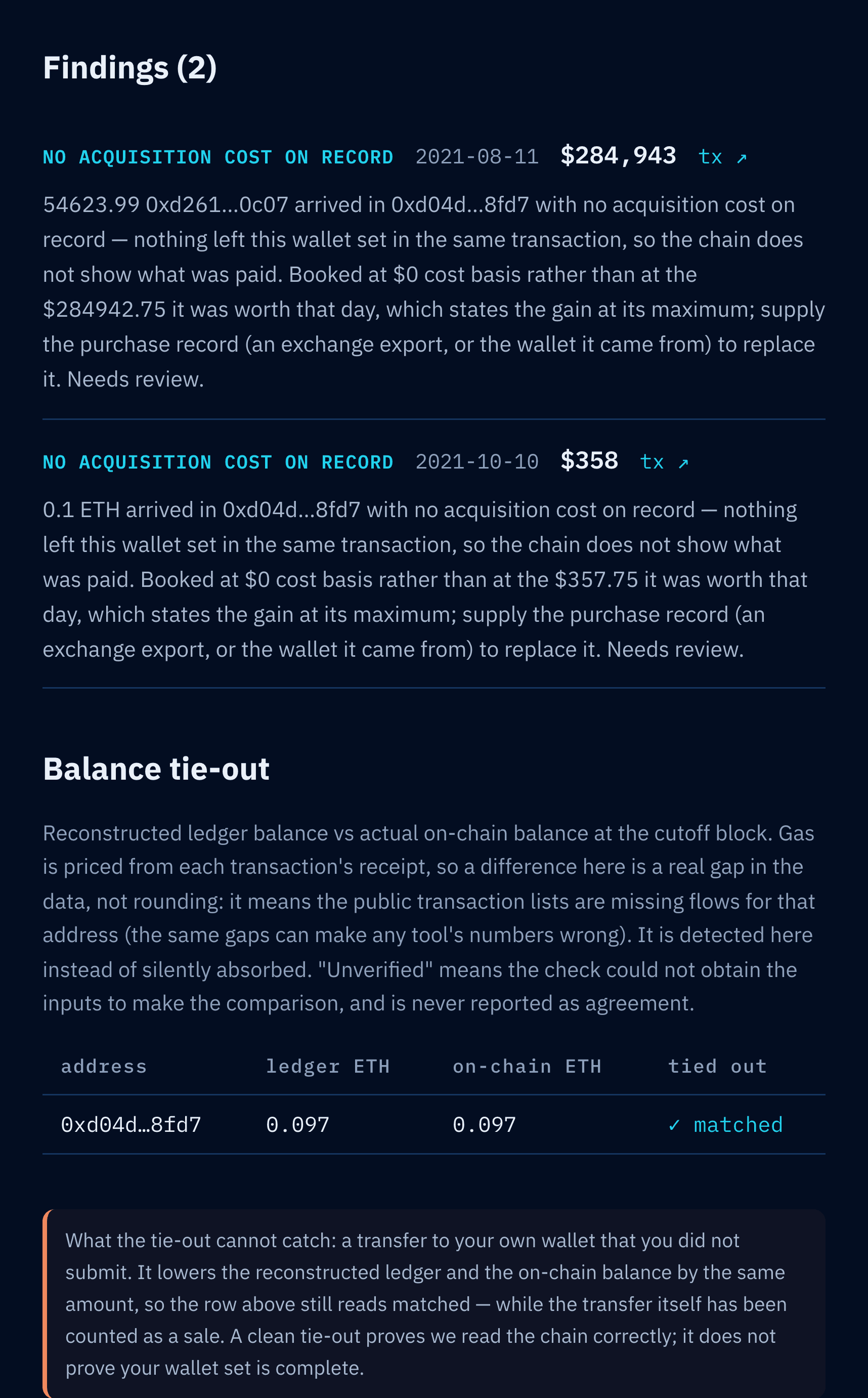
A real run on the smallest wallet of the cluster above — the cold wallet in the last row of the tie-out table, analyzed up to 2021‑12‑31, before its large 2022 inflow. Nothing had been sold at a $0 basis by that date, but two arrivals had no purchase price anywhere in the public record, so the scan books them at $0 rather than inventing one, and flags both. The bottom half is the reason to show it: every scan rebuilds your balance from the transaction list and ties it out against the actual on-chain balance (here 0.097 ETH vs 0.097 ETH), then withholds its dollar figures if the two don't meet. That isn't hypothetical — it is what happened to the run at the top of this panel.
The five addresses are attributed by on-chain ENS name, Etherscan public name tag, or mainstream press coverage — nothing here identifies anyone who is not already public, and Verilot is not affiliated with or endorsed by the owner. The run covers native ETH only, to a 2023-03-31 cutoff, with daily closing prices and FIFO lots, and every outflow leaving the cluster is modelled as a disposal at fair market value. "Naive" is our own engine with wallet linking switched off — the generic behavior of per-wallet cost-basis accounting, not a claim about any specific commercial product. Every input is public on-chain data and every figure above is the output of the run described here — but we have not yet published a step-by-step reproduction package, and the free scan (5 wallets, 500 events) is too small to re-run a cluster this size. Treat this as our measurement under our stated method, not an independently reproduced one. This is not tax advice.
Your wallets have their own version of this table. Check yours — read-only, no keys →
The public case study is a 5-event wallet whose balances tied out. The $45M Vitalik cluster is a mechanism footnote — same play (a transfer arrives with no purchase price), different scale. Start from the CSV row in your software, not from a whale headline.
Koinly or CoinTracker capital-gains export, or a broker 1099-DA. That file is the subject — not a whale headline.
Read-only, no wallet connection, no sign-up wall. Ethereum mainnet, Base or Arbitrum One — one chain per scan. Transfers to a wallet you leave out are counted as sales, so enter the set that moves coins between each other.
A table ranked by dollar amount: tx hash, and what to mark as a transfer in Koinly or CoinTracker. Not a tax ruling — a software checklist.
Rows ranked by dollar impact, each with a transaction hash and the software step. Figures below are the published public-wallet run — linked vs unlinked on the same data — not a typical filer's scan, and not anyone's tax position.
| Date | Asset | Amount | In your software | Tx |
|---|---|---|---|---|
| 2021-12-14 | ETH | $8,365,581 | Mark as transfer in your tax software | 0xad231f…385a6 ↗ |
| 2021-09-26 | ETH | $6,273,767 | Mark as transfer in your tax software | 0x404b80…fc99b ↗ |
| 2021-07-01 | ETH | $4,182,790 | Mark as transfer in your tax software | 0xce25ec…ffb8c ↗ |
The free scan stops at 500 on-chain events. The $79 pack continues that year and keeps the un-watermarked evidence package.
Most people finish with the free scan. The $79 pack is for when you need the complete evidence package and repair table to hand to your CPA.
$0
$79
We only ever read public chain data. We can't move funds — there's nothing to connect.
No deposits, no approvals, no smart-contract interactions.
We will never ask for a private key or seed phrase. If something claiming to be us does, it's a scam.
Each finding cites the transaction hash and the rule that fired. You verify us, not the other way around.
A 5-event public wallet. Tie-out matched to the wei.
Ordinary history, not a whale headline. Method and the completing sample are published. The Vitalik $45M cluster is a mechanism footnote — our engine, linked vs unlinked, not a measured error in someone else's software.
How the verifier is verified, and the edge cases the engine names →
Different job. Those tools try to compute your whole tax report across everything you've ever done. Verilot does one narrow thing: find the specific transactions where that kind of tool tends to break — bridge deposits, self-transfers between your own wallets, and disposals stripped of their cost basis — and quantify the damage with on-chain evidence. Think of it as a second opinion, not a replacement.
Never. Drop a Koinly, CoinTracker, or 1099-DA file, or paste a public address. We read the file and public blockchain data. There is nothing to sign, approve, or connect.
Ethereum mainnet, Base, and Arbitrum One — pick a chain per scan, up to 5 wallets and 500 events. Native ETH and ERC-20 only — not Bitcoin, Solana, Optimism, Polygon, NFTs, or other chains we haven't listed. Start with a Koinly or CoinTracker capital-gains CSV or a 1099-DA; an exchange CSV (Coinbase, Kraken, or a generic timestamp/type/asset/quantity/price_usd format) is live too. We'd rather be exactly right on what's shipped than promise fifty chains we haven't tested.
That depends on your return, not your address. Verilot is built around US tax reporting — Form 1099-DA, Form 8949, US cost-basis conventions — and the scan reads public chain data without asking where you live. Plenty of people outside the US file a US return, and plenty of US filers hold coins bought anywhere. Whether your coins belong on a US return is a call for your own tax professional; what we produce is the evidence either way.
The free scan stays free — up to 5 wallets and 500 on-chain events, cutoff 2025-12-31. 2025 tax-year pack: $79 once, no subscription. It finishes that year past the free event cap, with the repair table and the evidence package.
It's the new IRS form for digital assets. Brokers already report gross proceeds — that started with 2025 transactions, and the first forms went out in early 2026. Starting with 2026 transactions they report cost basis too, and those forms land in early 2027. The problem: brokers only see their own slice of your activity. If you self-custody or use DeFi, the basis they report (or fail to report) may not match reality — and it's on you to reconcile the difference on your return.
No. Verilot is not a tax, legal, or accounting advisor. What we produce is evidence: a reconciliation with a tx-hash on every line. We give you the evidence — you and your CPA decide what to do with it.
The waitlist row is your email, which page version you saw, and any campaign tags that were in the link you arrived from (the utm_ parameters) — nothing else. It's stored for product updates, never sold or shared, and deleted on request. When you later scan a wallet, we read public chain data — the same data anyone can see on a block explorer.
Your tax software treated transfers between your own wallets as sales.
Start with your CSVRead-only. No sign-up, no keys. 2025 tax year, about 60 seconds.
The scan needs an Ethereum, Base or Arbitrum One address you hold yourself. If your coins only sit on an exchange, if you use a chain we don't read yet, or if you're a CPA sizing this up before putting a client on it — leave an email and we'll write when there's something new for you to scan.
One email at a time, no drip campaign. Unsubscribe whenever.